News
From Canary to Stable: Managing Duplicati Release Channels Across Business Fleets
Updating enterprise backup systems shouldn't feel like a high-stakes gamble for busy IT teams. Learn how to structure Duplicati's release channels into a phased rollout strategy that delivers seamless feature adoption without sacrificing rock-solid fleet stability.
In enterprise IT, software updates are a perpetual tightrope walk. Update too slowly, and you miss out on performance improvements, bug fixes, and critical security patches. Update too aggressively without validation, and you risk disrupting business-critical processes; a nightmare scenario when the software in question manages your last line of defense: your backups.
To strike the right balance between early feature adoption and rock-solid reliability, sysadmins need a structured deployment strategy. Here is how to structure, stage, and automate Duplicati release channels across your business fleet.
1. Decoding the Duplicati Release Pipeline
Duplicati uses a four-stage release pipeline to move code from raw commits to production-ready builds. Understanding the risk profile and intent of each channel is the foundation of a safe fleet deployment strategy.
Release Channel | Target Audience | Risk Level | Primary Purpose |
Canary | Core developers, bleeding-edge testers | High | Real-time builds containing the absolute latest code commits. Unvalidated for general use. |
Experimental | Tech-savvy enthusiasts, lab environments | Medium-High | Feature-complete builds pushed for broader feedback prior to a Beta code freeze. |
Beta | IT staging fleets, early-adopter endpoints | Low-Medium | Polished candidate builds tested for regression, performance, and cross-platform compatibility. |
Stable | Production fleets, critical workloads | Minimal | Fully vetted, production-grade releases verified across diverse deployment environments. |
Key Rule of Thumb: Never deploy Canary or Experimental builds to production backup environments. They belong strictly in isolated lab environments or non-critical testing VMs.
2. Building a Tiered Staging Strategy (The "Ring" Model)
To catch environment-specific edge cases—such as subtle conflicts with local endpoint security tools, custom OS images, or complex network proxies—you should adopt a phased ring-deployment strategy.
Ring 0: The IT Lab (Canary / Experimental)
Scope: 1–2 non-essential test virtual machines managed directly by the backup administrator.
Goal: Test fundamental system compatibility with backup storage targets and evaluate new features early in the development cycle.
Ring 1: Staging & Early Adopters (Beta)
Scope: 5–10% of your total endpoint fleet, consisting of IT department laptops, secondary workstations, or staging servers.
Goal: Run Beta releases under real-world operating conditions for a 1- to 2-week "soak period." This exposes environment-specific edge cases—such as volume snapshot behavior (VSS/LVM) or proxy re-authentications—without putting core business operations at risk.
Ring 2: The Production Fleet (Stable)
Scope: 100% of production servers, executive endpoints, and business-critical devices.
Goal: Maximum availability and absolute predictability. Endpoints in this ring receive updates only after a build achieves full Stable status and passes your internal Ring 1 soak period.
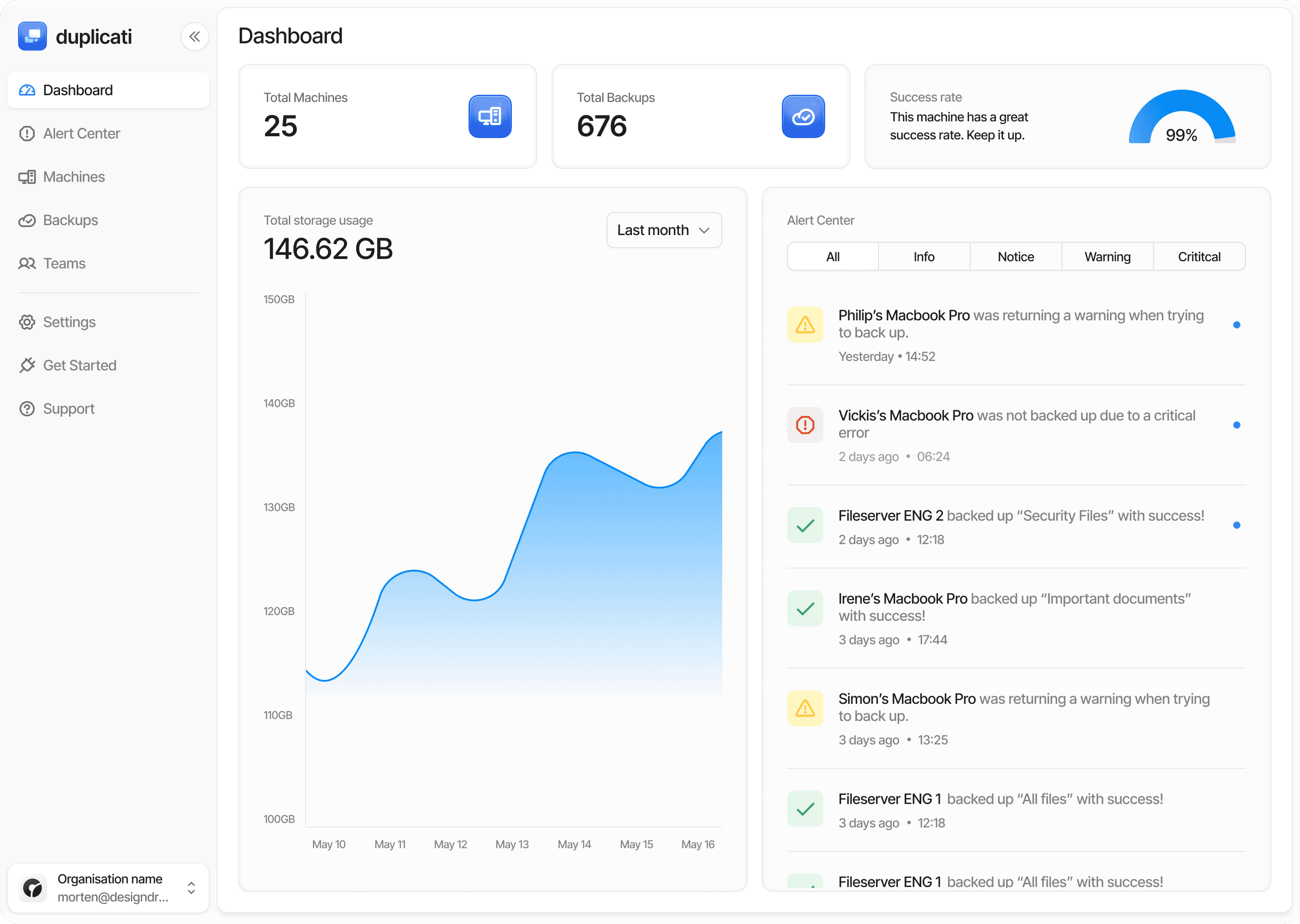
3. Centralized Fleet Rollouts via Duplicati Console
Managing update channels manually across dozens or hundreds of devices is inefficient and error-prone. To enforce update policies across your organization, sysadmins rely on the Duplicati Console for centralized management and fleet orchestration.
Key Policy Enforcement Features
Automated Rollout Schedules: Define explicit maintenance windows to prevent unexpected updates from running during peak operational hours.
Centralized Fleet Auditing: Maintain real-time visibility into client version distributions across your entire network. Easily identify legacy clients and enforce minimum security baselines.
Controlled Upgrades: Seamlessly manage lifecycle transitions. Once a Beta release proves reliable during its staging period, update your global fleet policy to push the corresponding Stable release to the rest of your fleet.
Final Thoughts: Reliability Through Structure
Backup software should be the most predictable component in your stack. By pairing Duplicati’s release channels with a tiered deployment ring and centralized console enforcement, you get the best of both worlds: rapid access to new features and absolute confidence in your fleet's data integrity.